

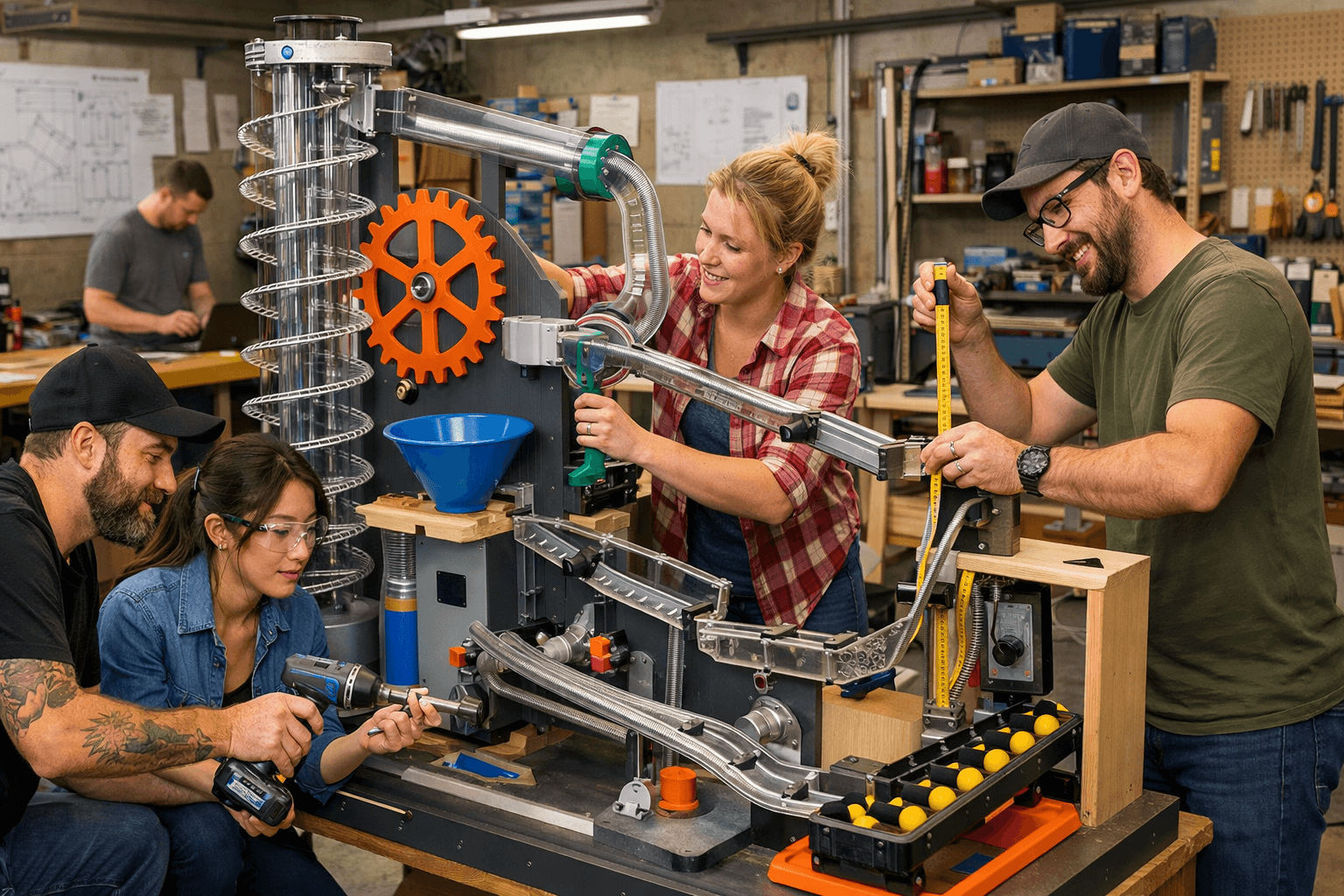
Ever wondered how the hands-on exhibits at science museums actually get built? From the first educational question to opening day, the process behind every great exhibit is as fascinating as the science it teaches.
"But how did they make that?" It's one of the most common questions children ask after a great science museum visit — and one of the most underrated. The tornado in the glass tube, the bridge that bends under weight, the circuit that lights up when you touch two points: none of it appears by magic. Behind every great exhibit is a team of designers, engineers, educators, and craftspeople who spent months — sometimes years — turning a scientific idea into something a child can touch, test, and remember.
It Starts With a Question, Not an Object
No science museum exhibit begins with a material or a mechanism. It begins with an educational question: What do we want visitors to understand that they don't understand now? That question — rigorously explored before a single sketch is drawn — becomes the foundation for every decision that follows. The best exhibits are slow to start and fast to build. Rushed ones cost far more to fix after opening than the time saved in planning was ever worth.
The Team Behind the Magic
Science museum exhibit designers are rare specialists who combine educational theory, industrial design, structural engineering, and visitor experience psychology. Their job is to translate an abstract concept into a physical object that a visitor can interact with and learn from — without reading a word of text.
The design process produces a fabrication package: technical drawings, material specs, and interaction logic. This goes to specialist manufacturers — exhibit fabricators — who build for environments where a single button may be pressed 400 times a day, by children of every age and enthusiasm level, for years on end. General manufacturers don't build for that. The best exhibit fabricators do nothing else.
Prototypes: Where Real Learning Happens
Before full-scale build begins, the team constructs a working prototype and tests it with real visitors. What they discover is almost always surprising. Adults design for how they imagine children will interact. Children interact in ways adults never imagined. Prototype testing catches problems at a fraction of the cost of fixing them in a finished exhibit — and the institutions that skip it almost always regret it.
What Exhibits Are Actually Made Of
Every material is chosen for durability, safety, and scientific clarity:
- Stainless steel — for interactive mechanisms; corrosion-resistant, survives relentless use
- HDPE panels — impact-resistant, splinter-free, easy to clean
- Tempered safety glass — for transparent sections that reveal internal mechanisms
- Industrial-grade electronics — rated for continuous operation in high-traffic, high-static environments
- Marine-grade powder coatings — UV-stable finishes built to last years of physical contact
After Fabrication: Installation & Commissioning
When the exhibit arrives at the museum, the work isn't finished. It must be positioned, secured, connected to power and data infrastructure, calibrated, and tested in its final environment. The commissioning phase — between installation and opening — is where the unexpected always happens: lighting interference, floor vibrations, airflow from HVAC affecting a wind exhibit. Experienced installers earn their fee here.
How This Makes Your Next Museum Visit Richer
Children who understand that a team of designers and engineers spent months crafting the experience they're having engage with more curiosity and more respect. Try these conversation starters on your next visit:
- "What do you think they had to figure out to make this work?"
- "How many people do you think helped build this?"
- "What would you change if you were the designer?"
At Scibro, our monthly STEM science kits (scibro.com/store) bring a smaller version of this experience home — every kit includes materials your child assembles, tests, and investigates themselves, building the same hands-on understanding a great exhibit provides, at your own pace.
Frequently Asked Questions
How long does it take to build a science museum exhibit?
A single large-scale exhibit typically takes 12–24 months from brief to opening. Simpler mechanical exhibits can be completed in 6–9 months. A full gallery of 15–20 exhibits usually runs 2–3 years from concept to opening.
Why do science museum exhibits sometimes break or go offline?
Interactive exhibits in busy museums receive 200–500 interactions per day. Wear on buttons, levers, and electronics is inevitable — the best museums run scheduled preventive maintenance to catch wear before it becomes failure.
Can children visit a science exhibit fabrication workshop?
Some science centers and fabricators offer behind-the-scenes school programs. These are among the most impactful STEM visits available — showing children that science and engineering are real careers in real workspaces. Contact your local science museum directly; these programs are often not widely advertised.