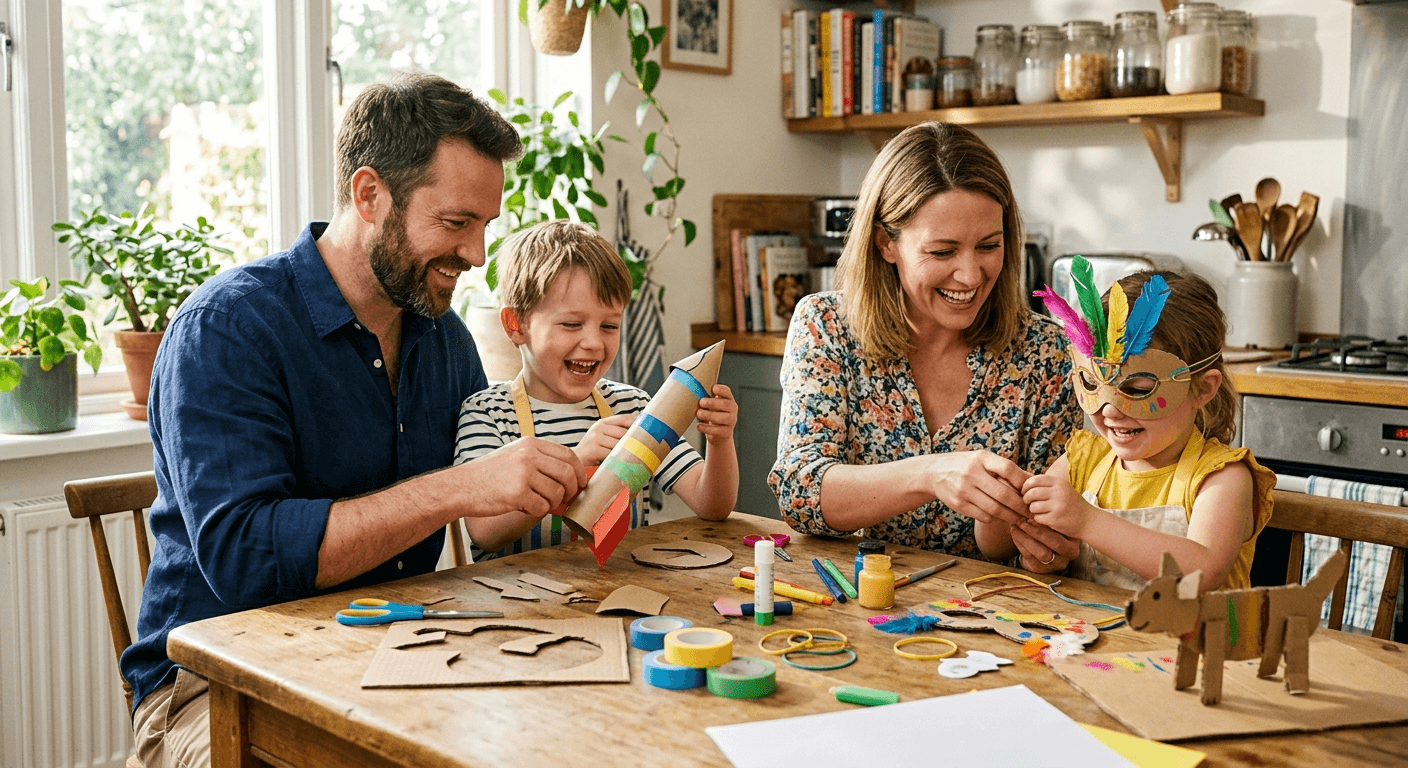
From paper airplanes to color-mixing experiments, DIY crafts for kids are one of the easiest ways to make learning feel like play. Here are the best activity ideas by age — all using materials you already have at home
The best DIY crafts for kids don't need a special kit or a tidy workspace. They need a cardboard box, some tape, and a child with something to figure out.
This guide covers simple, effective activity ideas sorted by age — so you can find the right starting point for your child and get going in minutes.
Ages 3–4: Mixing, Squishing, and Exploring
At this stage, the activity is the point — not the finished result. Focus on sensory materials that react visibly to touch.
Color Mixing with Water
Fill three clear cups with water and add different food coloring to each. Give your child a spoon and a fourth empty cup and let them combine colors freely. It is one of the simplest experiments for kids and produces immediate, satisfying results. Ask: "What do you think will happen if you mix those two?"
Clay and Dough Sculpting
Rolling, pressing, and shaping builds fine motor skills and introduces the concept that materials can be transformed by force. Use store-bought dough or make a simple flour-and-salt version at home. Let children create freely without a template.
Tear-and-Stick Collage
Tearing paper into shapes and arranging them on a larger sheet develops hand strength and spatial awareness. Add glue and let children compose their own pictures. No scissors needed at this age.
Ages 5–6: Building and Testing
Children at this age are ready for simple structures — and for the satisfying experience of watching something they built hold together (or dramatically fall apart).
Popsicle Stick Towers
Give children a pile of popsicle sticks and masking tape and challenge them to build the tallest freestanding tower they can. This is one of the most reliable craft activities for introducing balance and structural thinking. When it falls, ask: "Where did it break first? What would make that part stronger?"
Paper Boats (Float Test)
Fold a simple paper boat and test it in a sink or bowl of water. Then challenge children to improve the design so it holds more weight — add pennies one at a time until it sinks. This turns a basic paper craft into a genuine buoyancy experiment.
Cardboard Box Buildings
Collect cereal boxes, toilet rolls, and packaging and let children construct their own building or vehicle. The constraint of using only what is available pushes creative decision-making. Tape is the only tool needed.
Ages 7–9: Testing Variables and Moving Parts
Older primary-school children benefit from activities where they can change one thing and observe a different outcome — the foundation of real scientific thinking.
Paper Airplane Design Challenge
Make three paper airplanes with different wing shapes, then fly each one and measure how far it travels. This is among the best science project ideas for this age because it has a clear variable (wing shape), a measurable result (distance), and an obvious next question (what else could we change?).
Rubber Band Vehicles
Attach a rubber band to a small cardboard frame, wind it around a pencil axle, and release. Children can test different rubber band widths, axle lengths, and wheel materials to see what makes the car travel further. Simple to build, endlessly adjustable.
Marble Run
Use cardboard tubes cut in half lengthways, taped at different angles to a wall or door, to guide a marble from top to bottom. Children quickly discover how angle affects speed and how gaps between sections cause failures — applied physics through trial and error.
Tips for Getting More from Any Craft Session
- Ask before fixing: When something breaks, ask "What do you think went wrong?" before stepping in. The thinking that follows failure is often the most valuable part.
- Predict first: Before testing a design, ask your child to guess what will happen. Prediction sharpens attention during the activity.
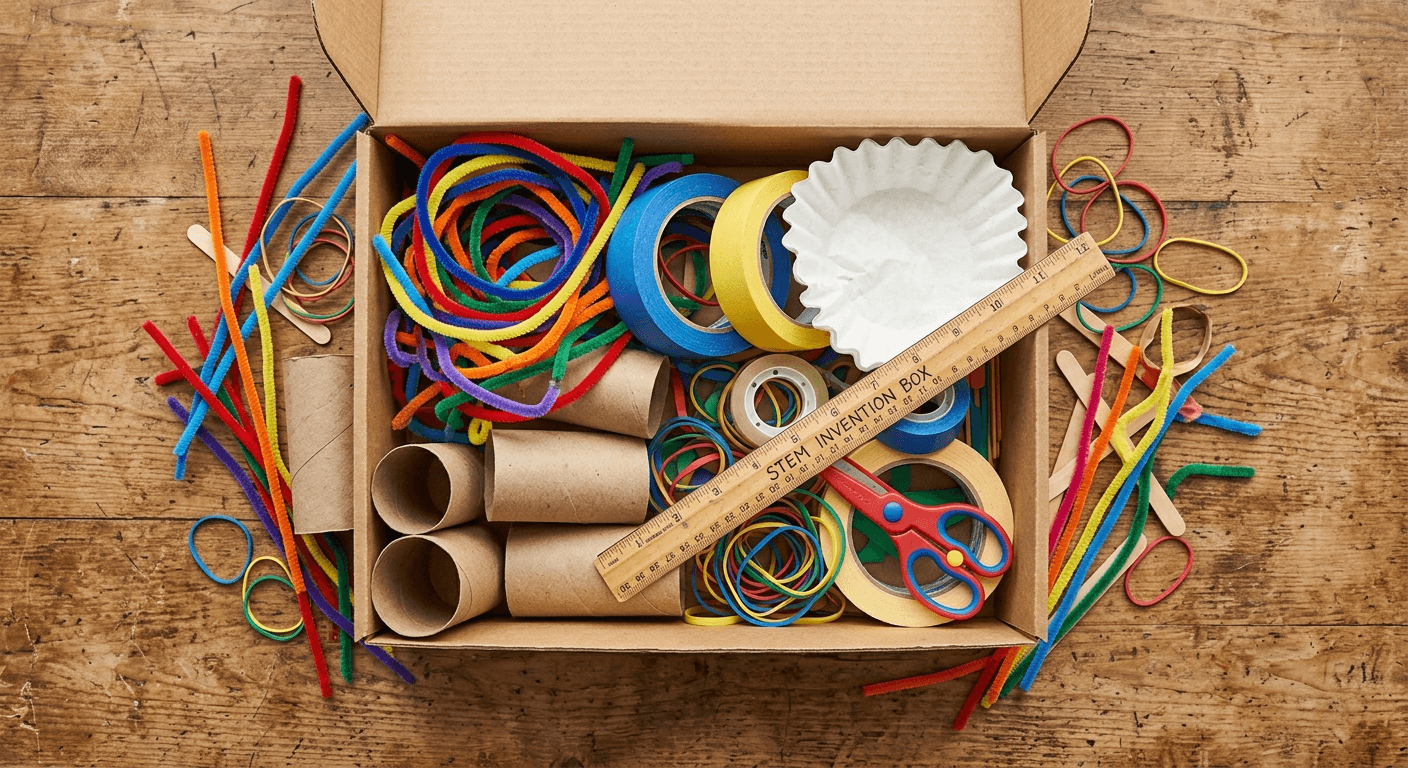
- Keep an invention box: A shoebox of cardboard tubes, tape, rubber bands, pipe cleaners, and foil means a good activity is always five minutes away.
- Brief reflection matters: Spend two minutes afterward asking what worked and what they would change. It locks in the learning without turning play into a lesson.
Frequently Asked Questions
What materials do I need for DIY crafts for kids?
Most of the best activities use what you already have: cardboard, paper, tape, rubber bands, food coloring, and basic kitchen supplies. An expensive craft kit is not required — open-ended materials often produce more creative results because children have to make their own decisions.
What are good craft activities for kindergarten-aged children?
Children aged 5 to 6 respond well to simple building challenges: popsicle stick towers, paper boats tested in water, and cardboard box constructions. The key at this age is to focus on the process — what happens when they test their design — rather than on producing a neat finished product.
How do DIY crafts connect to STEM activities?
DIY making and STEM activities share the same core process: try something, observe what happens, adjust, and try again. Children naturally run this cycle during craft sessions without needing to call it science. The connection becomes explicit when an adult asks a question like "why do you think that happened?" after an interesting result.