
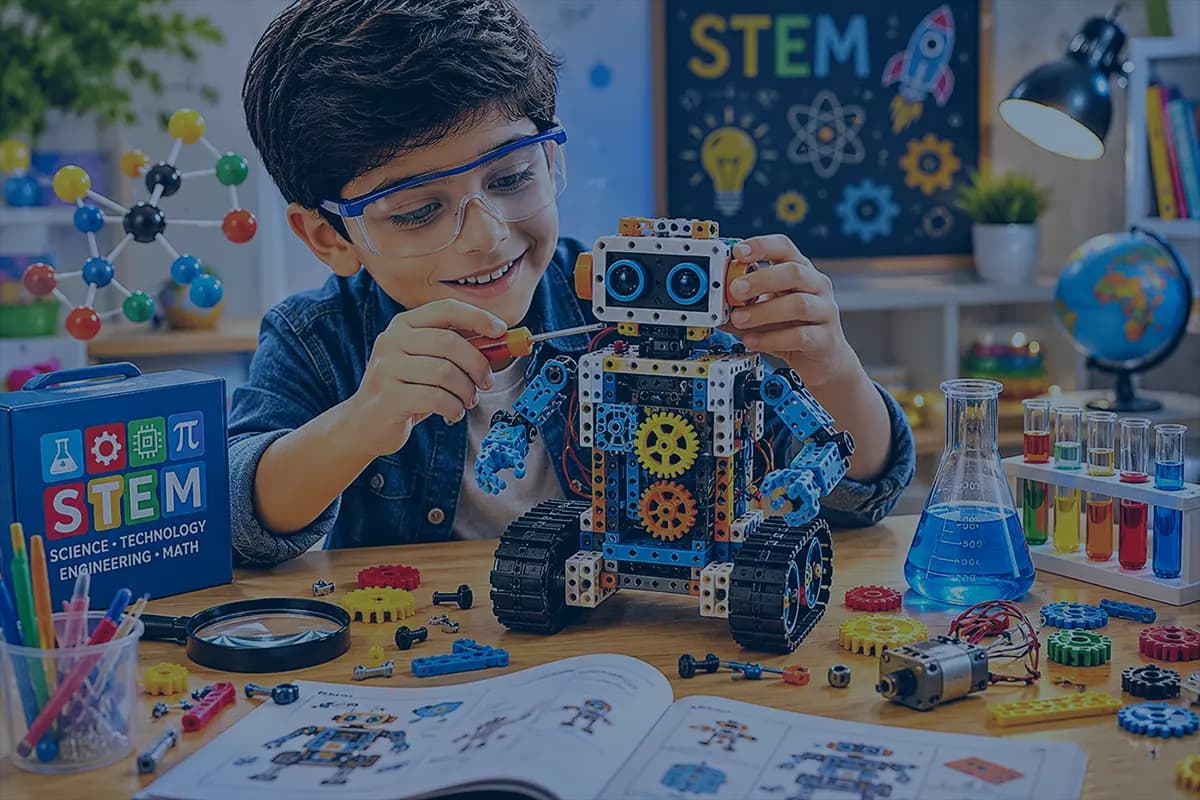
STEM toys aren't just fun — they're the building blocks of critical thinking, creativity, and problem-solving. This guide explains what STEM toys are, which subjects they cover, and how to choose the right educational kits for your child's age and interests.
What Are STEM Toys? A Complete Guide for Parents and Educators
STEM toys are one of the most impactful educational investments a parent or teacher can make. From robotic kits and coding games to chemistry sets and engineering challenges, STEM toys blend play with purposeful learning — helping children develop skills in science, technology, engineering, and mathematics long before they ever enter a classroom setting.
But with hundreds of options on the market, choosing the right educational toys can feel overwhelming. This guide breaks down exactly what STEM toys are, the subjects they cover, why they matter, and how to select the best STEM kits for your child's age and learning goals.
What Are STEM Learning Toys?
STEM learning toys are products specifically designed to introduce children to the core principles of science, technology, engineering, and mathematics through hands-on play. They include a wide range of formats: building sets, robotics kits, coding games, science experiment kits, and math puzzles — all structured to make complex concepts engaging and accessible.
Unlike passive entertainment, STEM toys require children to think, experiment, and solve problems. When a child builds a gear tower, programs a small robot to navigate a maze, or mixes safe chemicals to observe a reaction, they aren't just playing — they're developing a mental toolkit they'll use for the rest of their lives.
Scibro's curated range of science kits for kids is built on this exact principle: real learning happens when curiosity meets a well-designed challenge.
The Role of Play in STEM Education
Play is not the opposite of learning — it is one of the most effective vehicles for it. Research in child development consistently shows that children retain information more deeply when it is embedded in an enjoyable, low-stakes activity.
STEM education kits leverage this natural inclination for play by wrapping educational content in activities children genuinely want to engage with. The result is that concepts like force, buoyancy, or binary logic — which might feel abstract in a textbook — become intuitive through direct experience.
This is why hands-on science and interactive learning have become central to modern STEM education, both at home and in classrooms.
What Subjects Do STEM Toys Cover?
Quality STEM kits span the full range of STEM disciplines, each targeting different aspects of a child's development:
Science Kits — Encouraging Exploration and Experimentation
Science-focused kits provide materials for real experiments, guiding children to observe, hypothesize, and draw conclusions. From simple chemistry sets to physics and biology kits, these activities develop the scientific method and build a genuine curiosity about how the world works. Children learn to ask "why?" and "what if?" — two questions that drive all great discovery.
Technology Toys — Introducing Coding and Programming
Technology toys introduce children to basic programming concepts through interactive games and robotic devices. By working with programmable robots or coding apps, children develop logical thinking, sequencing, and algorithmic reasoning — skills that transfer directly to real-world problem-solving, not just computer science.
Engineering Sets — Building Structures and Solving Design Challenges
Construction kits and building sets teach engineering concepts by letting children experiment with gears, pulleys, levers, and structural design. Children discover how weight, balance, and force interact — and they experience the engineer's process of designing, testing, failing, and improving.
Mathematics Games — Making Math Accessible and Enjoyable
Math-focused toys use puzzles, board games, and interactive apps to teach counting, patterns, spatial reasoning, and early algebra. By making abstract concepts concrete, these educational toys help children build numerical confidence and develop a positive relationship with mathematics — something that pays dividends throughout their academic life.
Key Benefits of STEM Learning Kits
The case for including STEM learning kits in a child's environment goes well beyond academic readiness. Here are the most significant benefits:
Critical Thinking and Problem-Solving
STEM toys present open-ended challenges with no single correct answer. Children learn to analyze a situation, identify what they know and don't know, plan a course of action, and adjust when something doesn't work. This process — so central to success in adulthood — becomes second nature through repeated, playful practice.
Creativity and Innovation
Many STEM kits encourage open-ended building and experimentation, giving children the freedom to invent their own solutions. This creative dimension is often overlooked in discussions of STEM, but it is what transforms technical knowledge into genuine innovation.
Collaboration and Communication
Several interactive science experiments and group STEM kits are designed for shared play. Working together toward a goal, children practice expressing their ideas clearly, listening to others, and negotiating solutions — essential social skills that serve them far beyond the classroom.
Confidence and Resilience
Perhaps the most underrated benefit of STEM toys is what they teach children about failure. Because most kits involve trial and error, children repeatedly experience the cycle of attempting something, not succeeding immediately, adjusting their approach, and eventually getting it right. That experience — in a safe, playful context — builds real resilience.
How to Choose the Right STEM Toys and Kits
With so many options available, a few clear criteria can help you make the best choice:
- Match the toy to the child's age and developmental stage. A kit that's too advanced creates frustration; one that's too simple fails to engage. Always check the recommended age range, and consider your child's specific abilities and attention span.
- Follow the child's interests. A child fascinated by space will engage far more deeply with a rocket-building kit than a generic construction set. Interest is the engine that drives learning.
- Prioritize quality and safety. Look for non-toxic materials, durable construction, and clear safety certifications — especially for younger children. High-quality educational science kits also tend to provide a richer, more reliable play experience.
- Evaluate the educational content. Ask whether the kit teaches a specific skill, encourages experimentation, or aligns with a subject your child is currently exploring. The best STEM kits have visible learning goals, not just entertainment value.
- Read reviews from other parents and educators. Real-world feedback on durability, engagement, and educational impact is invaluable — especially for higher-priced items.
Getting Started with STEM at Home
You don't need a dedicated science room or a large budget to introduce STEM education at home. The right kit, matched to your child's age and curiosity, is enough to get started. Whether you're looking for your child's first science experiment kit or a more advanced robotics challenge for a teenager, the principle is the same: give children a real problem to solve, the tools to explore it, and the space to discover the answer themselves.
Explore Scibro's range of STEM kits for kids to find the right match for your child's age, interests, and learning goals.